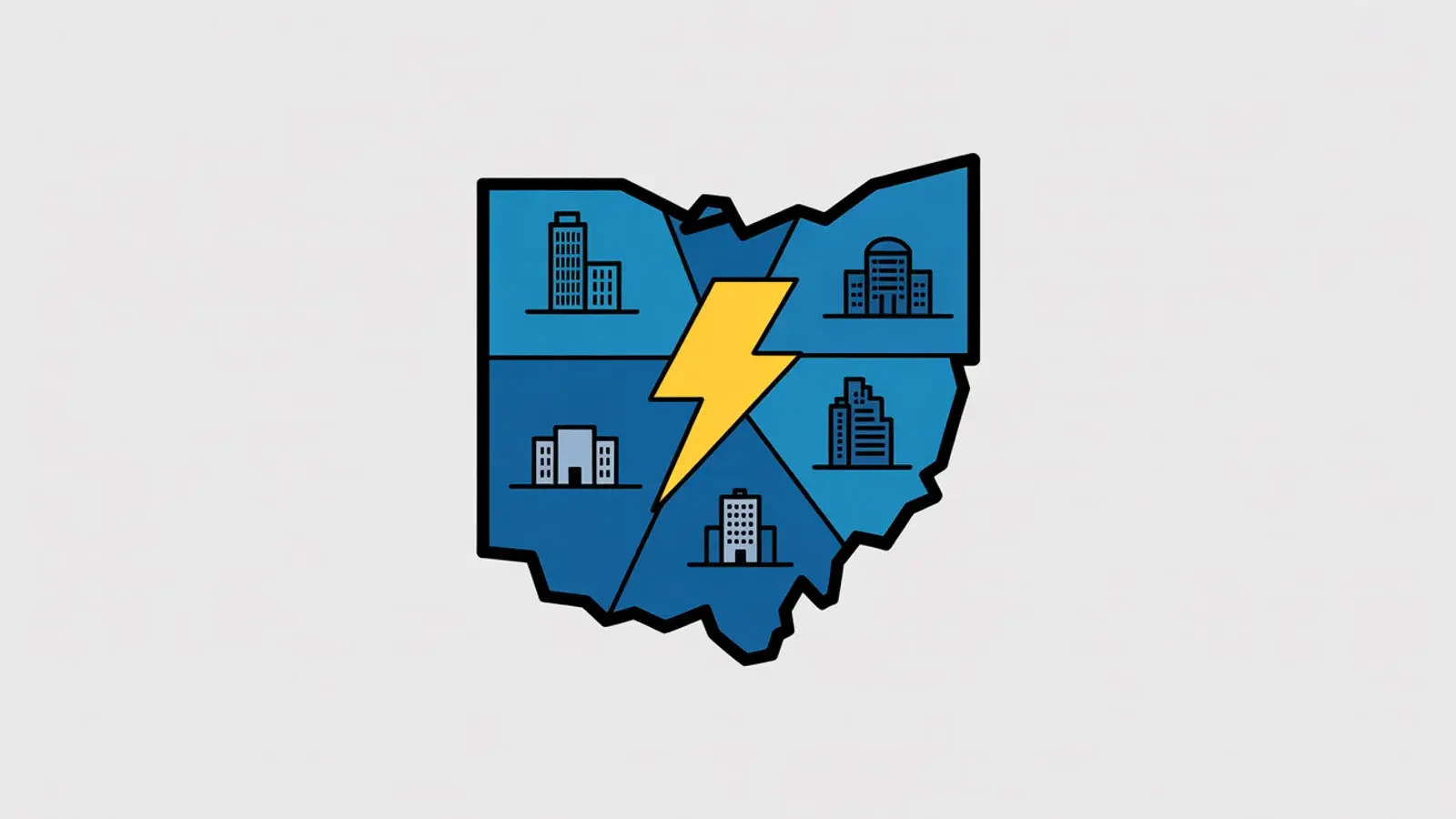

Ohio residents can choose their electricity supplier. The state enacted electric choice in 1999 through Senate Bill 3, making Ohio one of 14 U.S. states with deregulated residential electricity markets. Your distribution utility — AEP Ohio, FirstEnergy's Ohio companies, Duke Energy Ohio, or AES Ohio — still delivers power to your home, but you choose who supplies the generation.
The official comparison tool is Apples-to-Apples at energychoice.ohio.gov, maintained by the Public Utilities Commission of Ohio (PUCO). This guide explains how the Ohio market works, how to shop effectively, and what to watch out for.
The history of Ohio electric choice
Ohio's path to electric choice began with Senate Bill 3 in 1999, which restructured the state's electricity market to introduce retail competition. The rollout was phased across utility territories over several years.
Key milestones:
- 1999: Senate Bill 3 enacted, establishing framework for retail choice
- 2001-2002: Phased rollout to major utility territories
- 2008: Senate Bill 221 modified the structure, establishing the Standard Service Offer auction process
- Present: Full residential choice available statewide in investor-owned utility territories
Ohio's deregulation followed Pennsylvania's 1996 model and predated Texas's 2002 restructuring. All three states now have active competitive retail electricity markets, though the structures differ. Pennsylvania uses a "Price to Compare" benchmark; Texas has no default utility service; Ohio uses the Standard Service Offer (SSO) auction system.
How Ohio's market structure works
Understanding Ohio's market structure helps you shop more effectively.
Distribution utilities vs. competitive suppliers
Your electricity bill has two main components:
Distribution charges (utility — cannot be changed): Your local utility owns the poles, wires, meters, and infrastructure that delivers electricity to your home. They handle outages, read your meter, and maintain the grid. In Ohio, you cannot choose your distribution utility — it's determined by where you live.
Generation/supply charges (supplier — can be changed): This is the cost of the actual electricity you consume. In Ohio's deregulated market, you can shop for a competitive supplier who may offer rates different from your utility's default service.
The 5 major Ohio utilities
Ohio has five major investor-owned utilities where residential electric choice is available:
AEP Ohio (Ohio Power Company)
- Service area: Central and southeast Ohio, including Columbus
- Approximately 1.5 million customers
- SSO rates change periodically through competitive auction
FirstEnergy Ohio Companies FirstEnergy operates three distribution utilities in Ohio under separate names:
- Ohio Edison: Northeast Ohio, including Akron
- The Illuminating Company: Greater Cleveland area
- Toledo Edison: Northwest Ohio, including Toledo
- Combined approximately 2 million customers
Duke Energy Ohio
- Service area: Southwest Ohio, including Cincinnati
- Approximately 700,000 electric customers
- Also provides natural gas service
AES Ohio (formerly Dayton Power & Light)
- Service area: West-central Ohio, including Dayton
- Approximately 525,000 customers
- Rebranded from DP&L in 2021
Standard Service Offer (SSO) vs. competitive supplier
If you don't choose a competitive supplier, you receive electricity through your utility's Standard Service Offer. The SSO rate is determined through competitive auctions conducted by PUCO — suppliers bid to provide generation for customers who haven't shopped.
The SSO isn't necessarily the most expensive option, but it's also not guaranteed to be the cheapest. Comparing your current rate to available competitive rates is the only way to know if switching saves money.
Important: Some Ohio municipalities have community aggregation programs. If your city or township has an aggregation program, your default supplier may not be the utility's SSO — it may be the aggregation supplier. Check your bill to see who supplies your generation.
How to shop using Apples-to-Apples
The PUCO's Apples-to-Apples comparison tool at energychoice.ohio.gov is the official resource for comparing licensed suppliers in Ohio.
Using the tool
- Select your utility — Choose from AEP Ohio, Duke Energy Ohio, Ohio Edison, The Illuminating Company, Toledo Edison, or AES Ohio
- Filter options — Narrow by rate type (fixed, variable), term length, renewable content
- Compare offers — Review rates, terms, and plan details side-by-side
- Read the disclosure — Every offer links to a Plan Information Document with full terms
What to look for
Rate structure: Is the rate fixed (stays the same for the contract term) or variable (changes monthly)? Fixed rates provide budget certainty; variable rates can be lower but may spike during extreme weather or tight supply.
Contract term: Terms range from month-to-month to 36 months. Longer terms lock in your rate but may include early termination fees if you need to cancel.
Early termination fees: Many fixed-rate contracts include ETFs ranging from $50 to $200+. Know this before enrolling, especially if you might move.
Introductory vs. ongoing rates: Some suppliers offer very low rates for the first 1-3 months that reset to higher rates afterward. Read the full disclosure carefully.
Renewable energy content: If green energy matters to you, look for plans with renewable energy certificates (RECs). Some suppliers specialize in 100% renewable options.
The Plan Information Document
Every licensed supplier must provide a standardized disclosure document. In Ohio, this shows:
- The actual rate at different usage levels
- Any monthly fees that affect your effective rate
- Contract term and cancellation terms
- Renewable energy percentage
- Price variability (for variable-rate plans)
Read this document before enrolling. The advertised rate isn't always the rate you'll pay — monthly fees and tiered pricing can change the math.
Common Ohio shopper questions
Can I switch back to my utility's default service?
Yes. Ohio customers can always return to their utility's Standard Service Offer. There's no penalty for returning to SSO, though if you're leaving a competitive supplier's fixed-rate contract early, that supplier may charge an early termination fee.
How long does switching take?
Switching typically takes 1-2 billing cycles (about 30-60 days). You'll continue receiving service throughout the transition — there's no interruption.
Will my power get shut off during the switch?
No. Your distribution utility continues delivering electricity regardless of who supplies the generation. Switching suppliers is an administrative change that happens in the background.
Who do I call if there's an outage?
Always call your distribution utility for outages, regardless of who supplies your generation. The utility owns the infrastructure and handles all reliability issues:
- AEP Ohio: 1-800-672-2231
- FirstEnergy (Ohio Edison, Illuminating Co, Toledo Edison): 1-888-544-4877
- Duke Energy Ohio: 1-800-543-5599
- AES Ohio: 1-877-468-8243
What if I'm in an aggregation program?
Many Ohio municipalities and townships have community aggregation programs that negotiate electricity supply on behalf of residents. If you're in an aggregation, your default supplier is the aggregation supplier, not the utility's SSO.
You can opt out of aggregation and either return to SSO or choose your own competitive supplier. Check your bill or contact your local government to understand your aggregation status.
Ohio compared to other deregulated states
Ohio is one of 14 states plus Washington D.C. with residential electric choice. The market structure varies by state:
Pennsylvania deregulated in 1996 and uses the "Price to Compare" benchmark — a quarterly rate that serves as the comparison point for competitive offers. PA Power Switch is the official shopping tool.
Texas deregulated in 2002 and has the most fully competitive market. Texas has no default utility service — if you don't choose a supplier, you're assigned to a Provider of Last Resort at potentially unfavorable rates. Power to Choose is the official tool.
Ohio uses the Standard Service Offer auction system, which sets default rates through competitive bidding. Apples-to-Apples is the official comparison tool.
Other deregulated states include New York, New Jersey, Maryland, Massachusetts, Connecticut, Illinois, Michigan, Maine, New Hampshire, Rhode Island, and D.C. Each has slightly different rules and official tools.
For a complete overview of deregulated states, see our state-by-state electricity deregulation guide.
When does choosing a supplier save money?
The potential savings from shopping depend on several factors:
Compare to your current rate: Check your bill for your current generation/supply rate. If competitive suppliers offer rates meaningfully below your SSO or aggregation rate (1-2¢/kWh or more), switching may save $10-30/month for typical households.
Usage matters: Higher-usage households save more in absolute dollars from rate reductions. A 2¢/kWh savings on 1,500 kWh/month is $30/month; on 500 kWh/month, it's $10/month.
Consider the full picture: The lowest advertised rate isn't always the best deal. Factor in monthly fees, introductory rate resets, and customer service track records. A slightly higher rate from a well-reviewed supplier may be worth more than rock-bottom pricing from a supplier with complaint patterns.
When switching may NOT save money:
- Your SSO or aggregation rate is already competitive
- Available supplier rates aren't meaningfully lower
- You'd break a good fixed-rate contract to chase marginally lower rates
Common mistakes to avoid in Ohio
Door-to-door and telemarketing enrollments
Suppliers using aggressive in-person or phone sales generate higher complaint volumes. If someone approaches you at your door or calls unexpectedly, take their materials and compare rates on Apples-to-Apples before making any decisions. Never sign or verbally agree at the door.
For more on avoiding problematic sales tactics, see our guide on electricity scams and slamming.
Teaser rates that reset
Some suppliers advertise very low introductory rates that automatically increase after 1-3 months. These "teaser" rates attract customers, but the ongoing rate may be higher than SSO. American Power & Gas, for example, has documented patterns of introductory rates that reset to much higher levels.
Read the Plan Information Document to understand what happens after any promotional period ends.
Auto-renewal traps
Many contracts auto-renew when the initial term expires — often at a higher rate or as a variable-rate plan. Set a calendar reminder 30-60 days before your contract ends to review options and avoid unfavorable auto-renewal terms.
Not reading the disclosure
The advertised rate is marketing. The Plan Information Document is the contract. Monthly fees, tiered pricing, and usage thresholds can all change your effective rate. Read the disclosure before enrolling.
Suppliers operating in Ohio
Several suppliers we've reviewed operate in Ohio's competitive market:
- Direct Energy — Multi-state national brand with fixed and variable options
- Constellation Energy — Multi-state brand backed by largest U.S. nuclear fleet
- Inspire Clean Energy — 100% renewable subscription specialist
- IGS Energy — Ohio-headquartered regional player
- Public Power — Smaller value-focused supplier
Our supplier reviews provide detailed assessments across pricing, transparency, customer service, and green options. Check reviews before enrolling with any supplier, especially those advertising unusually low rates.
Note: Volt Butler's Ohio supplier coverage is expanding. Comprehensive Ohio supplier reviews and commercial pages are in development.
FAQ
When did Ohio deregulate electricity?
Ohio enacted electric choice in 1999 through Senate Bill 3. The rollout was phased across utility territories over several years, with full residential choice available statewide in investor-owned utility territories by the early 2000s. Senate Bill 221 in 2008 modified the structure and established the current Standard Service Offer auction process.
Who is my Ohio electric utility?
Your utility depends on where you live. AEP Ohio serves central and southeast Ohio including Columbus. FirstEnergy operates Ohio Edison (Akron area), The Illuminating Company (Cleveland area), and Toledo Edison (Toledo area). Duke Energy Ohio serves Cincinnati and southwest Ohio. AES Ohio serves Dayton and west-central Ohio. Check your electricity bill — the utility name appears prominently.
Is electric choice in Ohio worth it?
It depends on your current rate and available alternatives. If competitive suppliers offer rates meaningfully below your Standard Service Offer or aggregation rate, switching can save $100-300/year for typical households. If rates are similar, the effort may not be worthwhile. Compare your current rate to offers on Apples-to-Apples (energychoice.ohio.gov) to see if switching makes sense for your situation.
Can I switch back to my utility's default rate?
Yes. You can always return to your utility's Standard Service Offer. Contact your utility or simply let your competitive supplier contract expire without renewal. Note that if you're breaking a fixed-rate contract early, your current supplier may charge an early termination fee — that fee goes to the supplier, not the utility.
Are there scams to watch out for in Ohio?
The main risks are aggressive sales tactics and misleading rate advertising. Be cautious of door-to-door salespeople, unsolicited phone calls, and rates that seem too good to be true. "Slamming" (switching your supplier without authorization) is illegal but still occurs. Verify any enrollment you didn't initiate by calling PUCO at 1-800-686-7826. See our scams and slamming guide for detailed protection strategies.