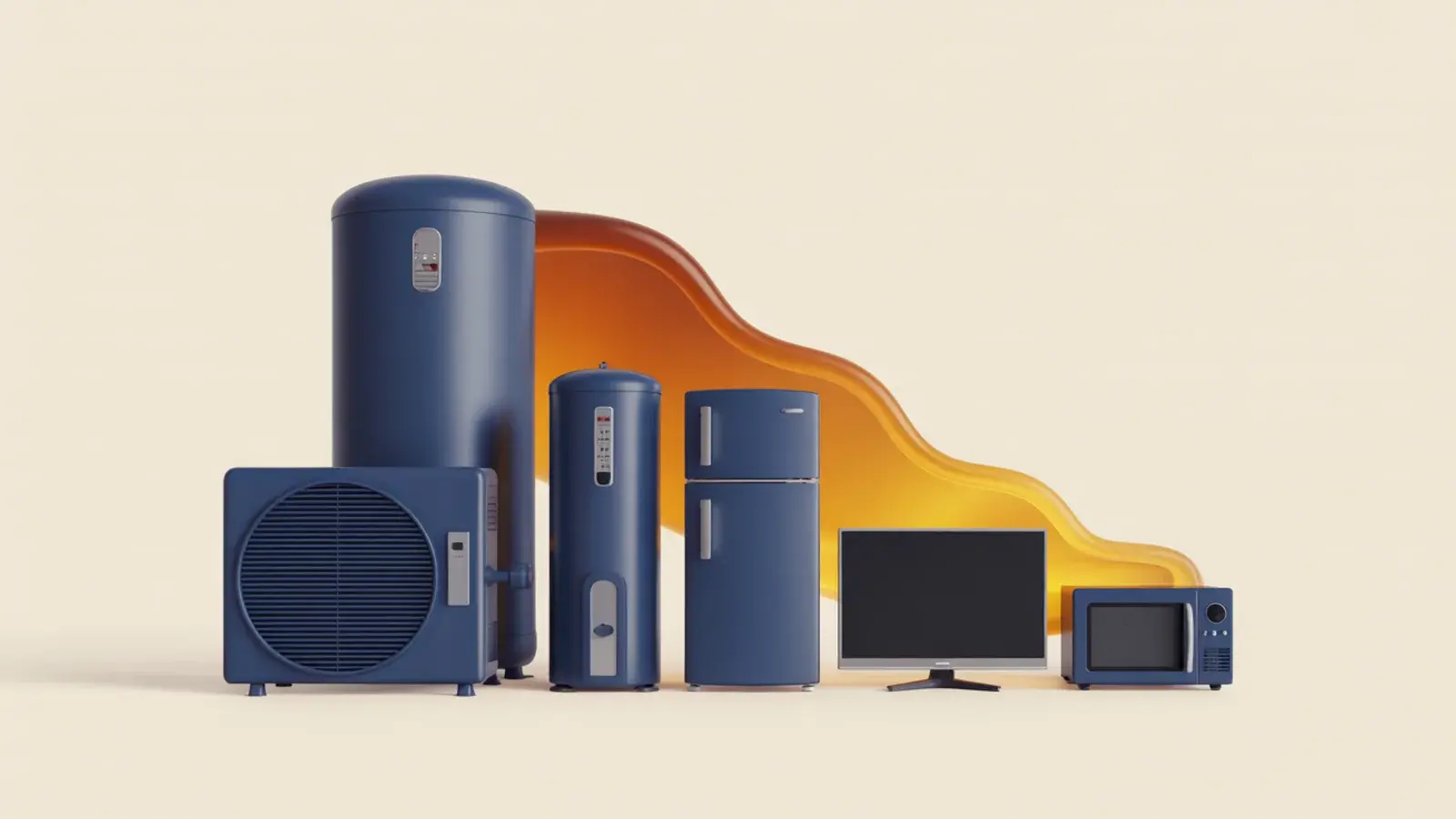

When people ask what uses the most electricity in their home, they usually picture the wrong culprit — a phone charger left plugged in, a TV on standby. The real answer is bigger and duller: the systems that move heat. Heating and cooling your home is almost always the largest single use, followed by heating your water, followed by a short list of large appliances. Everything else is rounding error by comparison.
This is the ranked, honest version — what actually drives a bill, roughly what each one costs at the U.S. average rate of about 16–17 cents per kilowatt-hour, and a link to a detailed cost calculator for each appliance so you can run your own numbers.
The short answer
The biggest electricity users in a typical home, in order:
- Heating and cooling (HVAC) — usually the single largest, around 40–50% of the bill (DOE).
- Water heating — often the biggest single appliance, roughly $60–80 a month for an electric tank.
- The refrigerator — modest hourly draw, but it runs 24/7, so it adds up.
- The clothes dryer — a big draw for the time it runs.
- Freezer, dishwasher, and the rest — smaller, steady contributors.
- Electronics, lighting, and standby power — real, but a small slice combined.
The pattern: what costs the most is a mix of how much power something draws and how many hours it runs. A high-wattage appliance used briefly can cost less than a modest one running constantly — which is why your refrigerator outranks your microwave.
Why heating and cooling dominates
Heating and cooling is the heavyweight in nearly every home — roughly 40–50% of a typical electric bill, per the U.S. Department of Energy. Nothing else is close.
In summer, that's air conditioning. A central AC unit can use around 600 kWh in a peak cooling month — roughly $100 — because the compressor runs for hours at a stretch. You can size your own cooling load with our air conditioner electricity cost calculator. In winter, homes that heat with electricity carry the same weight: a single 1,500-watt space heater run six hours a day costs about $44 a month, and whole-home electric heat costs far more.
This is why "unplug your charger" advice misses the point. If your bill is high, the thermostat is where the money is — not the gadgets.
Water heating: the runner-up
After HVAC, water heating is usually the largest single line. An electric water heater uses roughly 350–500 kWh a month — about $60–80 — which often makes it the biggest individual appliance in the house. See what yours costs with the water heater electricity cost calculator. Lowering the tank thermostat to 120°F and insulating an older tank are the two changes that move it.
The big appliances that run a lot
Below water heating sits a tier of large appliances. None rivals HVAC, but together they're a meaningful share of the bill.
- Refrigerator — a modern fridge uses about 100–220 kWh a month ($13–44). Its draw is modest, but it never turns off, so it lands among the top users every year. Refrigerator cost calculator
- Clothes dryer — about 3 kWh per load, or roughly 90 kWh a month (~$15) for a typical household. The heat is the cost; a heat-pump model uses about half. Dryer cost calculator
- Freezer — a standalone freezer adds about 25–100 kWh a month ($4–16), depending on size and whether it's a chest or upright. Freezer cost calculator
- Dishwasher — about 1–2 kWh per cycle (15–60 kWh a month, $2.50–10), and most of that is heating water and air-drying. Dishwasher cost calculator
The small stuff (it's genuinely small)
This is the tier people overestimate. Added up over a month, it's a fraction of what HVAC costs in a single week.
- Television — 10–80 kWh a month ($2–13), depending on screen size and type. TV cost calculator
- Microwave — 3–15 kWh a month, under $2.50. The high wattage only runs for minutes at a time. Microwave cost calculator
- Ceiling fan — just 15–90 watts, about $1–3 a month, and it can let you raise the thermostat to save far more. Ceiling fan cost calculator
- Coffee maker — draws around 1,500 watts while brewing, but only briefly; the hidden cost is a warming plate left on for hours. Coffee maker cost calculator
"But what about leaving things plugged in?"
This is the question behind a lot of energy anxiety, so here's the honest answer. Standby or "phantom" power — the trickle devices draw while off or idle — is real, but it's small: roughly 5–10% of a home's electricity use, spread across dozens of devices each pulling a few watts.
So unplugging idle electronics or using a smart power strip is worth doing — it's free money at the margins. But it is not a fix for a high bill, and any advice that leads with "unplug everything" is pointing you at a rounding error while the air conditioner runs. If your bill jumped, the cause is almost always heating, cooling, or hot water — not the toaster you left plugged in. (If you're trying to figure out a specific spike, our guide on why your electric bill is so high walks through the usual causes.)
What to actually do about it
Start where the energy actually goes, not where the myths point:
- Audit your own usage. National averages are a guide, not your bill. Run your appliances through our electricity cost calculator to see your real breakdown — it converts wattage and hours into kWh and dollars.
- Work the big levers first. Thermostat discipline and water-heater settings move real money; the small stuff doesn't. Our guide on how to lower your electric bill ranks the levers by impact.
- Skip the trivia as a "fix." Phantom-power tidying helps at the edges — just don't expect it to change the bill the way managing HVAC will.
Knowing the ranking is the whole game: spend your effort proportional to where the kilowatt-hours go. (New to the unit itself? See what a kWh is.)
FAQ
What uses the most electricity in a home?
Heating and cooling — your HVAC system — is the single largest electricity user in most homes, at roughly 40–50% of the bill (DOE). After that, water heating is usually the biggest individual appliance (about $60–80 a month for an electric tank), followed by the refrigerator (which runs constantly) and the clothes dryer. Electronics, lighting, and standby power are a much smaller combined slice. Start any bill-cutting effort with heating, cooling, and hot water.
Do appliances use power when they're off?
Yes, but not much. Many devices draw a small "standby" or "phantom" load while off or idle — a TV, game console, charger, or smart speaker might pull a few watts continuously. Across a whole home this adds up to roughly 5–10% of electricity use. It's worth trimming with a smart power strip, but it's a minor share compared with heating, cooling, and water heating.
Does unplugging things actually save money?
A little. Unplugging idle electronics eliminates their standby draw, which is real but small — typically a few percent of your bill across many devices. It's free and worth doing, but it won't meaningfully lower a high bill on its own. The large savings come from managing the big users: your thermostat, your water heater, and your major appliances.
What is the biggest energy user in a house?
For the whole system, it's heating and cooling (HVAC), at around 40–50% of a typical bill. For a single appliance, it's usually the electric water heater, at roughly $60–80 a month. The refrigerator is often the next-biggest single appliance over a full year, not because it draws a lot at once, but because it never turns off.
Why is my refrigerator a top energy user if it doesn't draw much power?
Because total electricity use is power multiplied by time, and a refrigerator runs 24 hours a day, every day. Its hourly draw is modest, but those hours never stop, so the kilowatt-hours accumulate. A high-wattage appliance used for a few minutes — like a microwave — can cost less over a month than a low-wattage one that runs constantly. It's the running time, not just the wattage, that makes a refrigerator a top user.