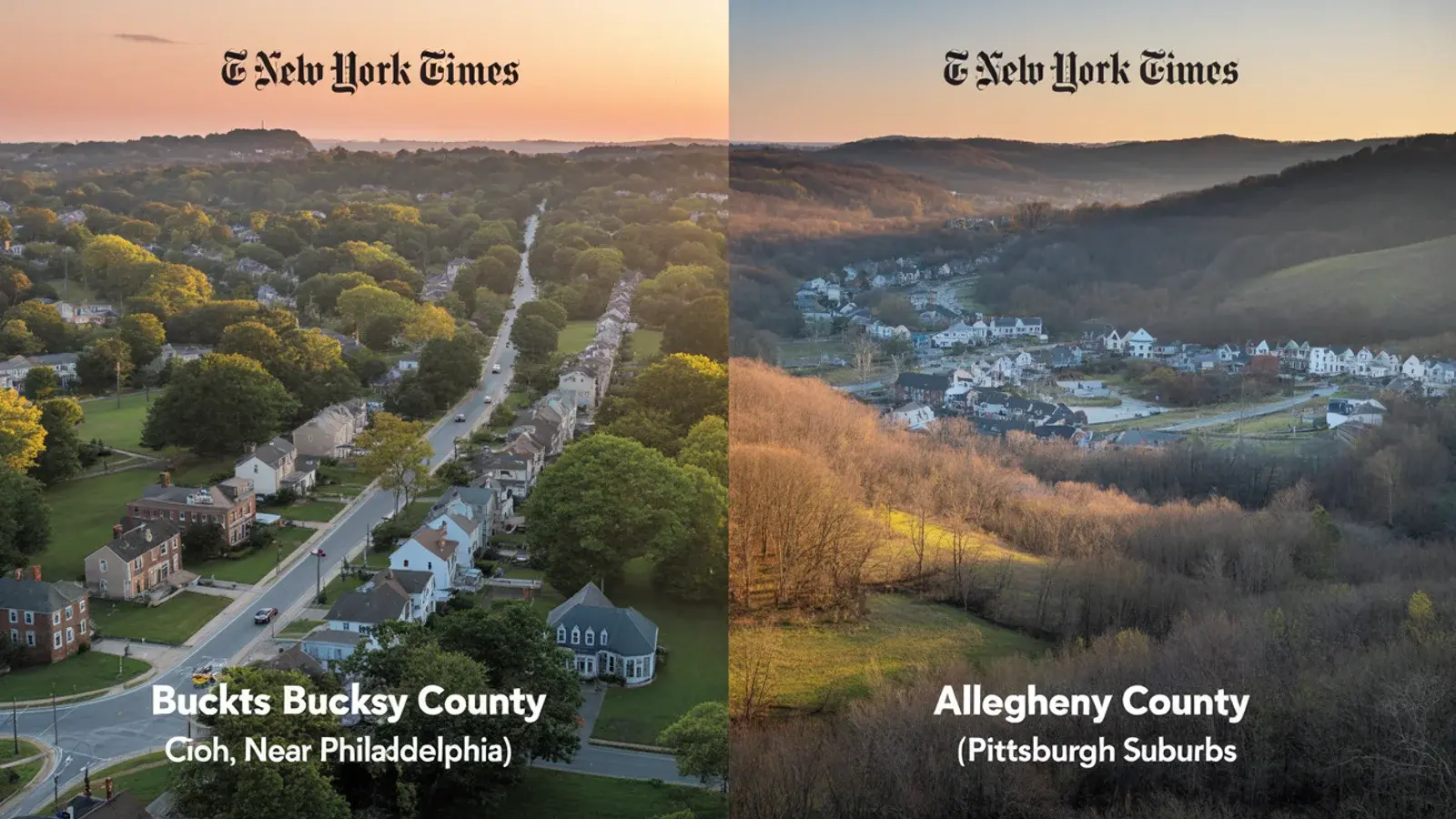

Bucks County households pay 11.024 cents per kilowatt-hour for default electricity supply. Allegheny County households pay 13.75 cents. That is a 25% difference between two of Pennsylvania's most populous suburban counties, separated by 300 miles and served by different utilities.
The gap is structural. Bucks County lies in PECO territory; Allegheny County lies in Duquesne Light territory. The utilities have different procurement strategies, different corporate structures, and different rate case histories — all of which produce different retail rates.
The rate gap by the numbers
Both counties operate under Pennsylvania's deregulated electricity market. Customers who never choose a supplier pay their utility's default rate, called the Price to Compare (PTC). Here is how that benchmark stacks up:
| Metric | Bucks County (PECO) | Allegheny County (Duquesne Light) |
|---|---|---|
| Current PTC (through May 31) | 11.024¢/kWh | 13.75¢/kWh |
| June 2026 PTC | 11.572¢/kWh | 14.14¢/kWh |
| Increase | +5.0% | +2.8% |
| Residential customers | ~1.7 million (PECO total) | ~600,000 |
At average Pennsylvania household usage of 850 kWh per month, the supply portion of your bill looks like this:
- Bucks County (PECO): $93.70 per month
- Allegheny County (Duquesne Light): $116.88 per month
- Difference: $23.18 per month, or roughly $278 per year
That annual gap is substantial. For context, it is roughly equivalent to two months of additional electricity supply charges per year.
For the latest PECO rate details, see our PECO Price to Compare update. For Duquesne Light, see our Duquesne Light Price to Compare update.
Why PECO and Duquesne Light rates differ
Both utilities purchase capacity and energy through PJM Interconnection, the regional grid operator that serves 65 million people across 13 states. Both are subject to the same wholesale market dynamics, including the 833% capacity auction price spike that has driven rates higher across Pennsylvania since 2024.
Yet their default rates diverge. Several factors explain the gap:
Corporate structure. PECO is a subsidiary of Exelon, one of the nation's largest utility holding companies. Duquesne Light is an independent utility, not part of a multi-state conglomerate. Different ownership structures create different approaches to procurement, capital allocation, and regulatory strategy.
Service territory scale. PECO serves approximately 1.7 million residential customers across southeastern Pennsylvania. Duquesne Light serves about 600,000 customers in the Pittsburgh metro area. Larger customer bases can spread fixed costs more broadly, though this is only one factor among many.
Procurement strategies. Utilities purchase wholesale power through a combination of long-term contracts, short-term market purchases, and capacity obligations. The timing and structure of these purchases affects how quickly wholesale price changes flow through to retail rates. PECO and Duquesne Light do not purchase power identically.
Rate case timing. Pennsylvania utilities file rate cases with the Public Utility Commission to adjust their charges. The timing of these filings, and the specific cost allocations approved, create differences that persist between rate case cycles.
The result is that two suburban Pennsylvania households using the same amount of electricity can pay 25% different rates simply because they live in different utility territories.
For more on how Pennsylvania's deregulated market structures these costs, see our guide to Pennsylvania electricity deregulation.
How usage patterns differ between the counties
Rate is only half the equation. Your bill equals rate times usage. Bucks County and Allegheny County households use electricity differently.
Housing stock. Both counties are heavily suburban, with single-family homes dominating. Bucks County's housing stock includes historic homes in towns like Doylestown and Newtown, plus large amounts of post-war suburban development. Allegheny County has similar variety, from older neighborhoods surrounding Pittsburgh to newer suburban construction. Both counties trend toward larger homes than their respective urban cores, which typically means higher electricity usage.
Climate. Allegheny County sits in western Pennsylvania, with slightly colder winters than Bucks County in the southeast. Both counties experience hot, humid summers. The climate difference modestly affects heating and cooling costs, though most Pennsylvania homes use natural gas for heat, making electric heating a smaller factor than it would be in all-electric regions.
Demographics. Both counties are among Pennsylvania's wealthiest and most populous suburban areas. Household sizes, income levels, and appliance ownership are broadly similar. Neither county has the extremely dense housing that characterizes Philadelphia or Pittsburgh proper.
The practical implication: usage patterns between these two suburban counties are fairly similar. The rate difference is the primary driver of the bill gap, not dramatic differences in consumption.
Supplier competition by county
Pennsylvania's deregulated market means you can choose your electricity supplier regardless of which utility serves you. Both Bucks County and Allegheny County have active competitive markets:
| Metric | Bucks County (PECO) | Allegheny County (Duquesne Light) |
|---|---|---|
| Active supplier plans | 122 | 107 |
| Number of suppliers | 54 | 54 |
| Cheapest available rate | 9.09¢/kWh | 10.79¢/kWh |
Both markets have robust competition with the same number of suppliers. Bucks County has slightly more plans available, and the cheapest available rate is lower — 9.09¢ versus 10.79¢. The competitive market does not erase the gap between territories; it mirrors it.
You can browse current plans for PECO territory and Duquesne Light territory on our utility pages.
Which county's residents benefit more from switching
Here is the math that matters: how much can you save by switching from the default rate to the cheapest available plan?
Bucks County (PECO):
- Default rate: 11.024¢/kWh
- Cheapest available: 9.09¢/kWh
- Savings: 1.93¢/kWh
- At 850 kWh/month: $16.41 per month, $197 per year
Allegheny County (Duquesne Light):
- Default rate: 13.75¢/kWh
- Cheapest available: 10.79¢/kWh
- Savings: 2.96¢/kWh
- At 850 kWh/month: $25.16 per month, $302 per year
Allegheny County residents who switch save about $105 more per year than Bucks County residents who switch. The gap between Duquesne Light's default rate and competitive rates is wider, making switching especially valuable.
This creates an ironic dynamic: Allegheny County residents pay more by default, but they can also save more by shopping. Bucks County residents start from a lower baseline, but their upside from switching is smaller.
In both counties, switching is free, takes about five minutes, and does not interrupt service. For step-by-step instructions, see our guide to switching suppliers in Pennsylvania.
What is the same across both counties
Despite the rate differences, Bucks County and Allegheny County electricity customers share more than they differ:
Same wholesale market. Both utilities purchase power through PJM. The same capacity auction results, the same coal plant retirements, and the same data center demand growth affect both territories. The 833% capacity price increase has pushed rates higher across Pennsylvania.
Same legal right to switch. Pennsylvania law gives every residential customer the right to choose their electricity supplier. Your utility cannot prevent you from switching, and the process is the same regardless of whether you have PECO or Duquesne Light.
Same utility role. Your utility handles delivery regardless of your supplier choice. PECO still delivers power, maintains the grid, and responds to outages for Bucks County customers. Duquesne Light does the same for Allegheny County customers. Switching suppliers only changes who supplies your electricity, not who delivers it.
Same bill structure. Both utilities send a single bill that includes supply charges (from your supplier or the default rate) and delivery charges (from the utility). The mechanics work the same way.
FAQ
Why is electricity more expensive in Allegheny County than Bucks County?
Allegheny County is served by Duquesne Light, an independent utility with different procurement strategies than PECO (which serves Bucks County). Corporate structure, customer base size, and rate case timing all contribute to the rate gap. Geography alone does not determine rates — utility procurement decisions do.
Can I get the same supplier plan in both counties?
Many suppliers operate in both PECO and Duquesne Light territories, but rates vary by utility zone. A supplier might offer 9.5¢/kWh in Bucks County and 11¢/kWh in Allegheny County for the same plan name. Always check rates for your specific ZIP code.
Do I need to do anything differently when switching in Allegheny County vs. Bucks County?
No. The process is identical. Enter your ZIP code on PA Power Switch or a comparison site, compare rates against your utility's Price to Compare, and enroll online with your utility account number. The switch takes one to two billing cycles to complete in both territories.
If I move from Bucks County to Allegheny County, does my supplier switch transfer?
No. You will need to establish new service with Duquesne Light and separately enroll with a supplier in that territory. Your PECO supplier plan does not transfer to a different utility's service area, even if the same supplier operates in both territories.